How Gamuda Made Digital Transformation an Operating Capability
By aligning people, process, technology, data and governance, Gamuda built repeatable digital practices that can scale across complex projects, regions and disciplines.
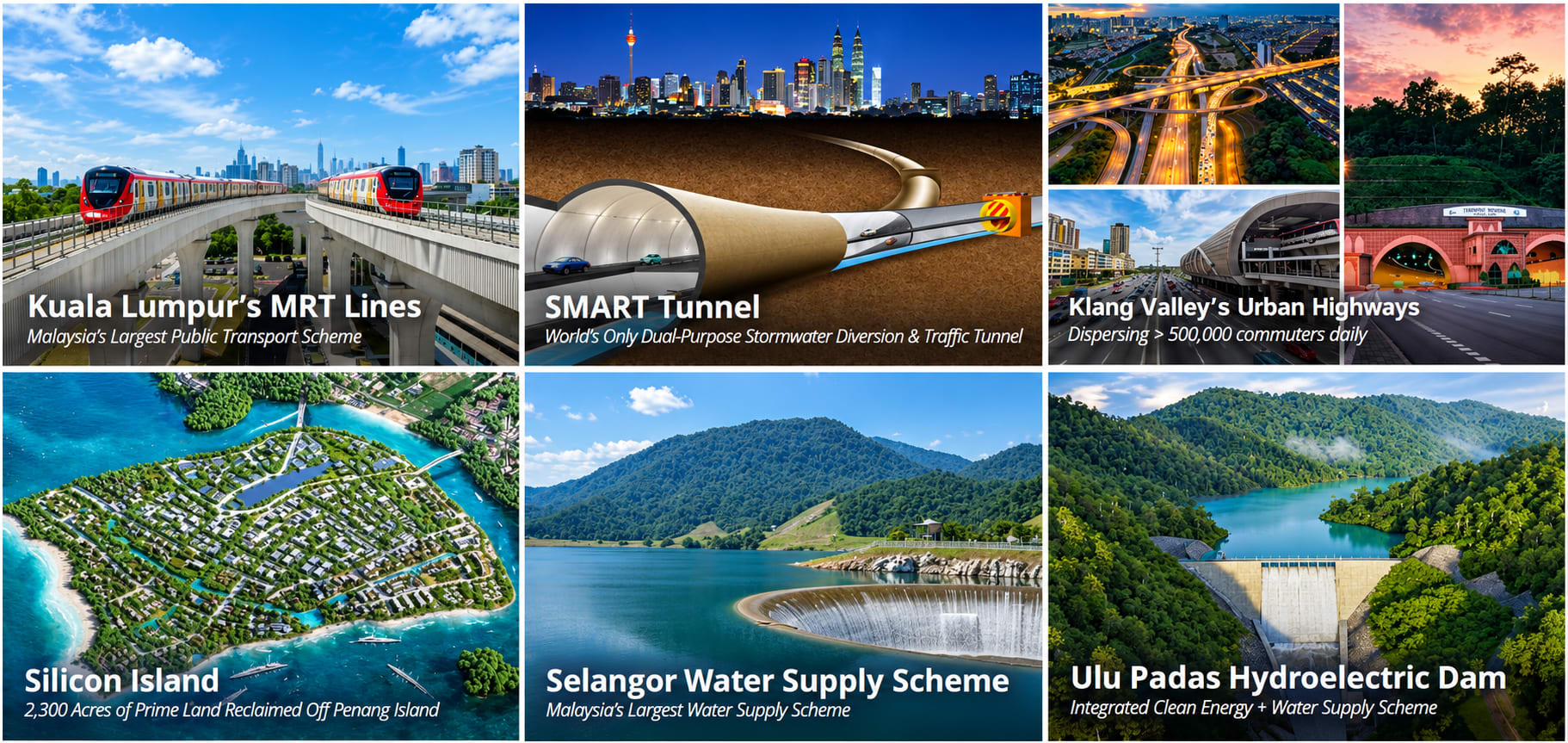
Representative projects from Gamuda’s 50-year Malaysian infrastructure portfolio, spanning mass transit, tunnelling, highways, land reclamation, water supply and renewable energy
Executive summary
Gamuda’s challenge was not simply to deploy more digital tools. A diverse portfolio of infrastructure, transport, water, energy and building projects created a more fundamental need: a repeatable way for project teams to work, capture information and make decisions across locations and disciplines.
Gamuda responded by refining a Digital Operating Framework that connects standardized ways of working with a common technology and data architecture. People remain the engine of change; processes define how work should happen; technology gives those processes reach; structured data creates visibility; and governance keeps the system coherent as it scales. Autodesk Forma (formerly Autodesk Construction Cloud) is a central part of that environment, alongside Primavera P6, SAP S/4HANA and Gamuda’s own digital capabilities.
THE BUSINESS IMPERATIVE
Complexity at scale made repeatability a business requirement
Complexity at scale made repeatability a business requirement With a 50-year infrastructure heritage and more than $16 billion of critical infrastructure under delivery across the region, Gamuda operates in an environment where project complexity is compounded by geographic scale. Its portfolio spans major rail, tunnelling, water, renewable-energy and building programs, with teams, partners and supply chains working across multiple markets.
For Gamuda, digitalization therefore has two linked business purposes. It can strengthen competitiveness and support new opportunities, but it also has to improve the way work is executed: standardizing practices, reducing avoidable handoffs, supporting cross-border collaboration and turning project activity into usable data. That makes the objective broader than digitizing existing paperwork or moving isolated systems to the cloud.
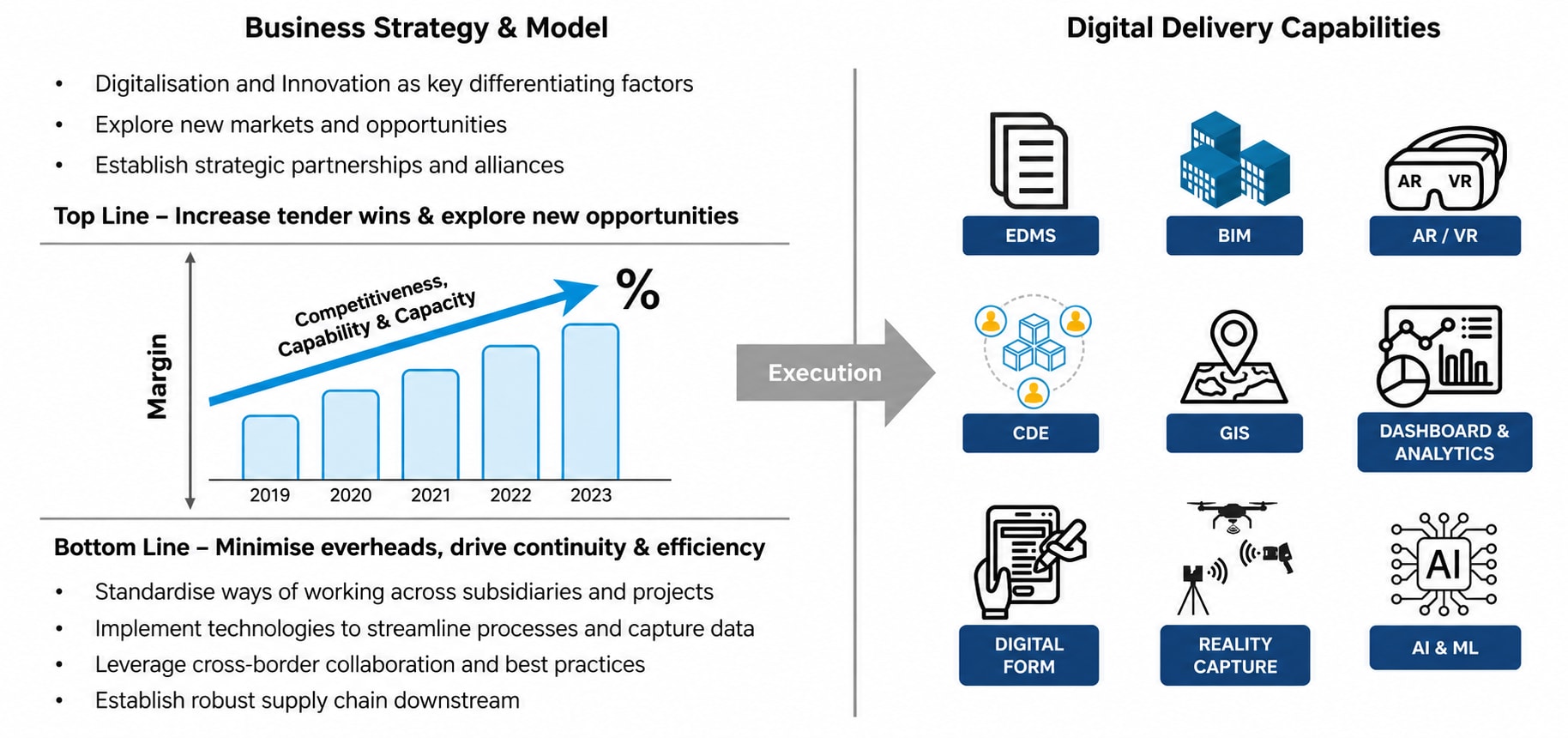
Gamuda links digital capability to both business growth and operational discipline: standard ways of working, streamlined processes, data capture and collaboration.
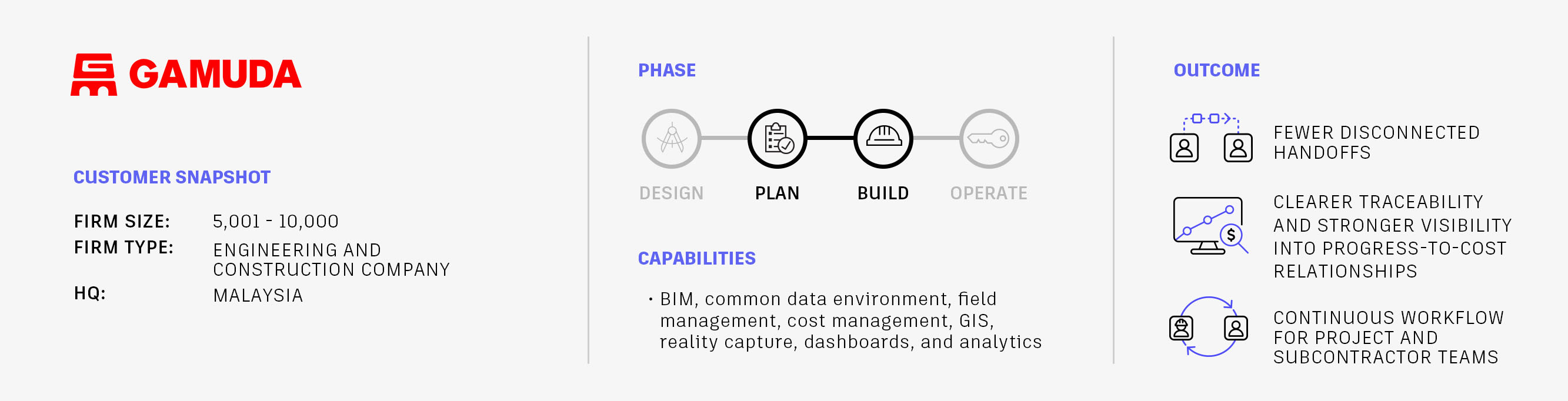
Customer snapshot
|
Headquarters |
Malaysia |
|
Business context |
50-year infrastructure heritage; major projects across multiple countries and sectors |
|
Core operating systems |
Primavera P6 for planning and scheduling; Autodesk Forma for connected project workflows; SAP S/4HANA for enterprise resource management |
|
Data layer |
Google Cloud data warehouse with Power BI and Data Studio for consolidated reporting |
|
Digital capabilities |
BIM, common data environment, field management, cost management, GIS, reality capture, dashboards and analytics |
|
Internal innovation |
BIM AR and Trudax, Gamuda-developed capabilities connected to the wider digital ecosystem |
THE OPERATING MODEL
Gamuda’s transformation model is deliberately systemic. Its strategy places people, processes and technology around data, then wraps those elements in three reinforcing layers: training and upskilling, standard ways of working, and systems and governance. The logic is important. Technology can make a task digital, but it cannot by itself make that task repeatable, trusted or useful across an enterprise.
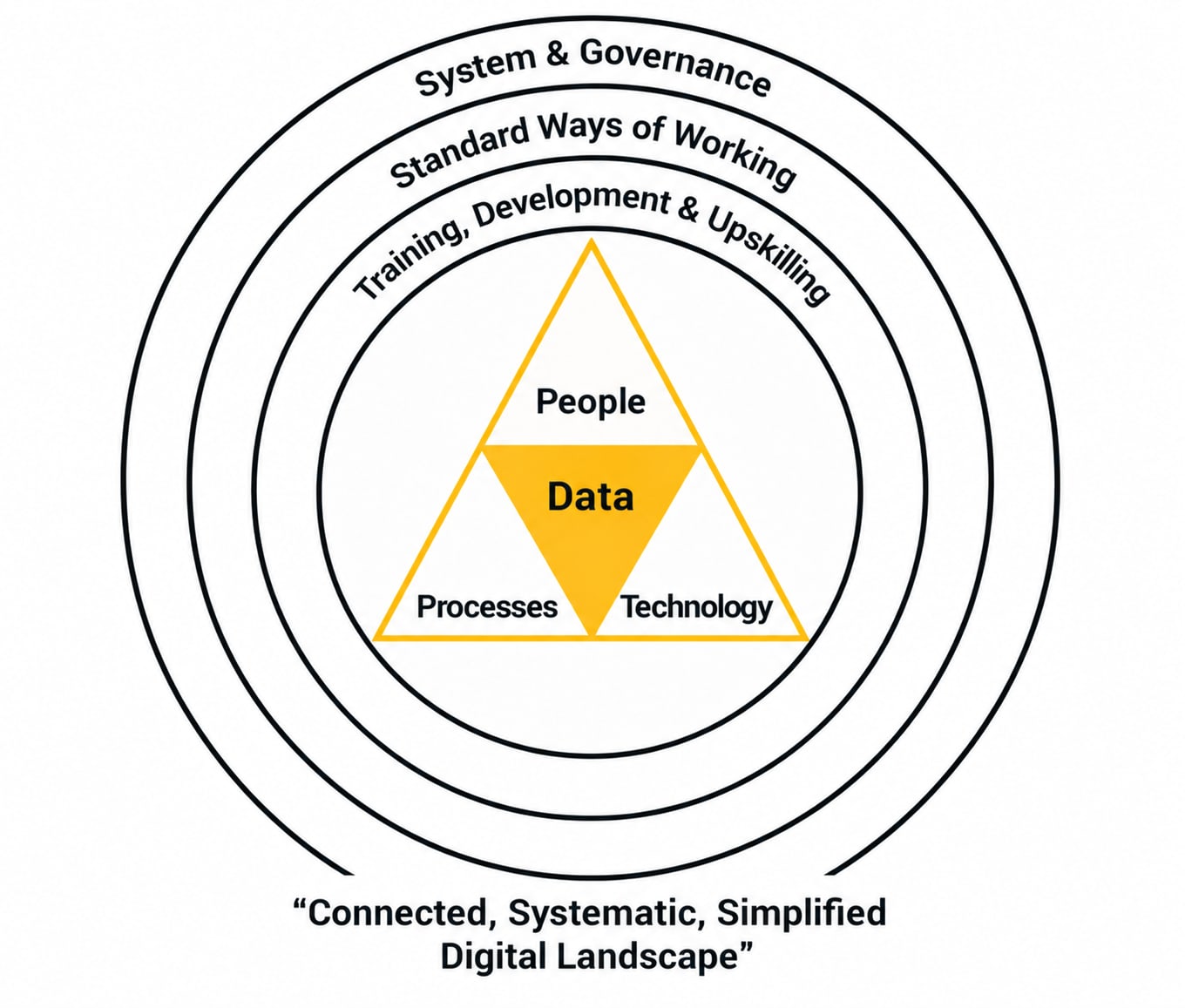
Gamuda’s digital transformation strategy: people, processes and technology generate and use data, while capability building, standards and governance make the model durable.
Standardization creates scale. Common workflows and templates reduce variation between projects. That makes onboarding easier, gives teams a clearer operating baseline and produces data that can be compared and consolidated instead of cleaned project by project.
Governance creates a stable foundation for innovation. Gamuda uses governance to establish common systems, processes and expectations. The aim is not to suppress experimentation, but to prevent successful local innovations from fragmenting the enterprise when they scale.
|
STANDARDIZE |
The compounding effect: repeatable processes generate more consistent data; consistent data improves enterprise visibility; stronger visibility creates a better basis for analytics, automation and AI. |
PEOPLE AND CAPABILITY
Adoption becomes durable when leadership mandate meets working-level ownership
Gamuda calls its change model a “convergence approach”: top-down direction is deliberately paired with bottom-up participation. Senior management reinforces the vision, allocates resources, sets governance and KPIs, and is regularly educated on technologies such as AI, cloud and BIM. At working level, communities, champions and practitioners turn that mandate into routines that make sense on real projects.
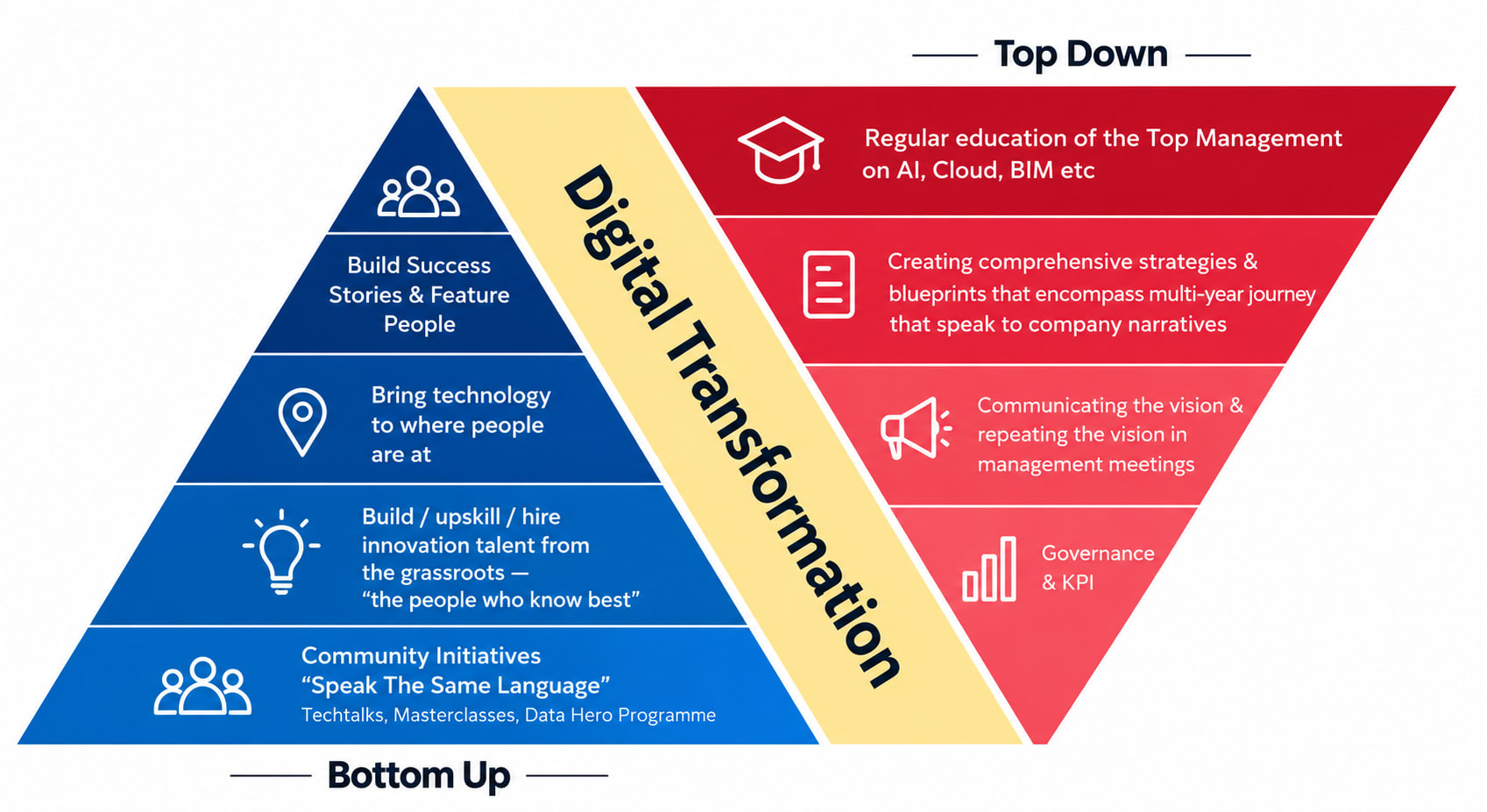
he capability system is deliberately broad. Gamuda’s scholarship program has supported more than 1,152 Malaysian youths since 1996. Internally, the DataHero Programme, TechTalks and BIM courses create recurring opportunities to learn; AI and digitalization are also embedded in staff performance expectations. The Gamuda AI Academy extends that capability-building mindset to software engineering and AI, with more than 350 students upskilled since October 2024.
This matters because adoption is not a communications exercise that ends at go-live. New digital workflows change how site teams request approvals, how designers coordinate, how commercial teams certify payments and how managers interpret performance. Continuous training and trusted peers help turn those changes into organizational competence rather than temporary compliance.
|
STRUCTURE |
People before platforms: technology only creates value when teams understand why the workflow matters, trust the process, and can use it confidently in day-to-day delivery. |
CONNECTED WORKFLOWS
Gamuda’s Digital Operating Framework avoids the assumption that one application should do everything. Instead, it gives core systems defined roles and connects them around common project practices. Primavera P6 supports planning and scheduling; Autodesk Forma supports common data, design coordination, field and cost-management workflows; SAP S/4HANA supports enterprise resource management; and APIs and connectors move information into the wider data environment.
That architecture matters because replacing disconnected desktop tools with disconnected cloud tools would simply reproduce the original problem. Integration preserves process continuity across functions while allowing specialist systems to do what they do best. It also gives Gamuda a foundation for its own innovation. Its in-house BIM AR application, for example, brings current BIM information to the site for validation and issue capture, then connects those issues back into the Autodesk environment.
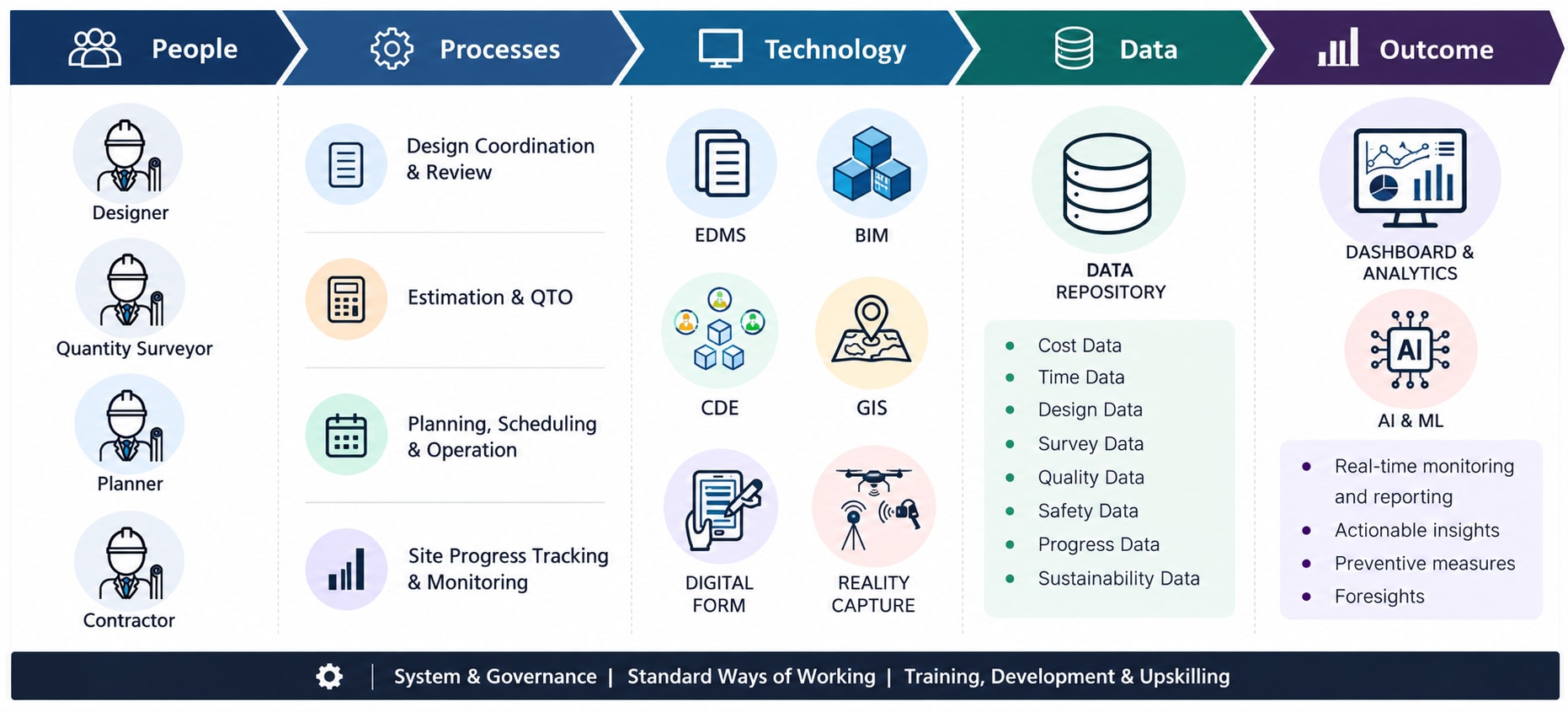
The end-to-end model connects project roles and processes to BIM, common data, field capture and other technologies, producing structured data that can support monitoring, analytics and AI.
The platform is an enabler, not the operating model. Gamuda defines the standards, governance, roles and internal innovations. Autodesk Forma provides a connected environment in which many of those workflows can be executed consistently and at enterprise scale.
FROM DATA CAPTURE TO INTELLIGENCE
A permit, quality inspection, model issue or payment application has immediate operational value. But once those activities are handled through structured digital workflows, they also become reusable data. Gamuda’s architecture is designed to make that second-order value explicit.
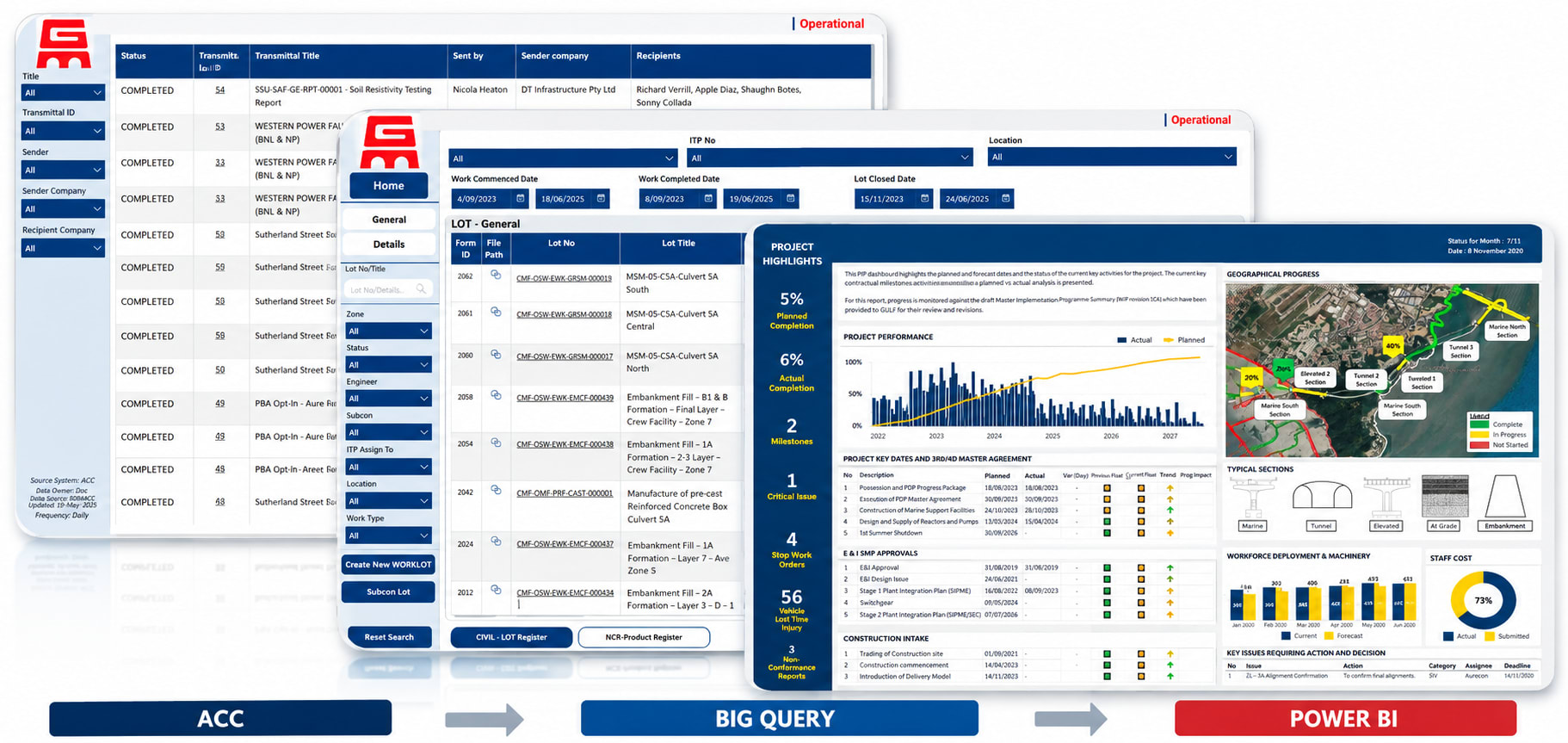
Project data - including cost, time, design, survey, quality, safety, progress and sustainability information - is extracted from source systems through APIs and consolidated in a Google Cloud data warehouse. There it can be compiled and sanitized before being surfaced through Power BI and Data Studio. Gamuda uses dashboards at different levels of the organization, from operational views for site teams to management and executive reporting.
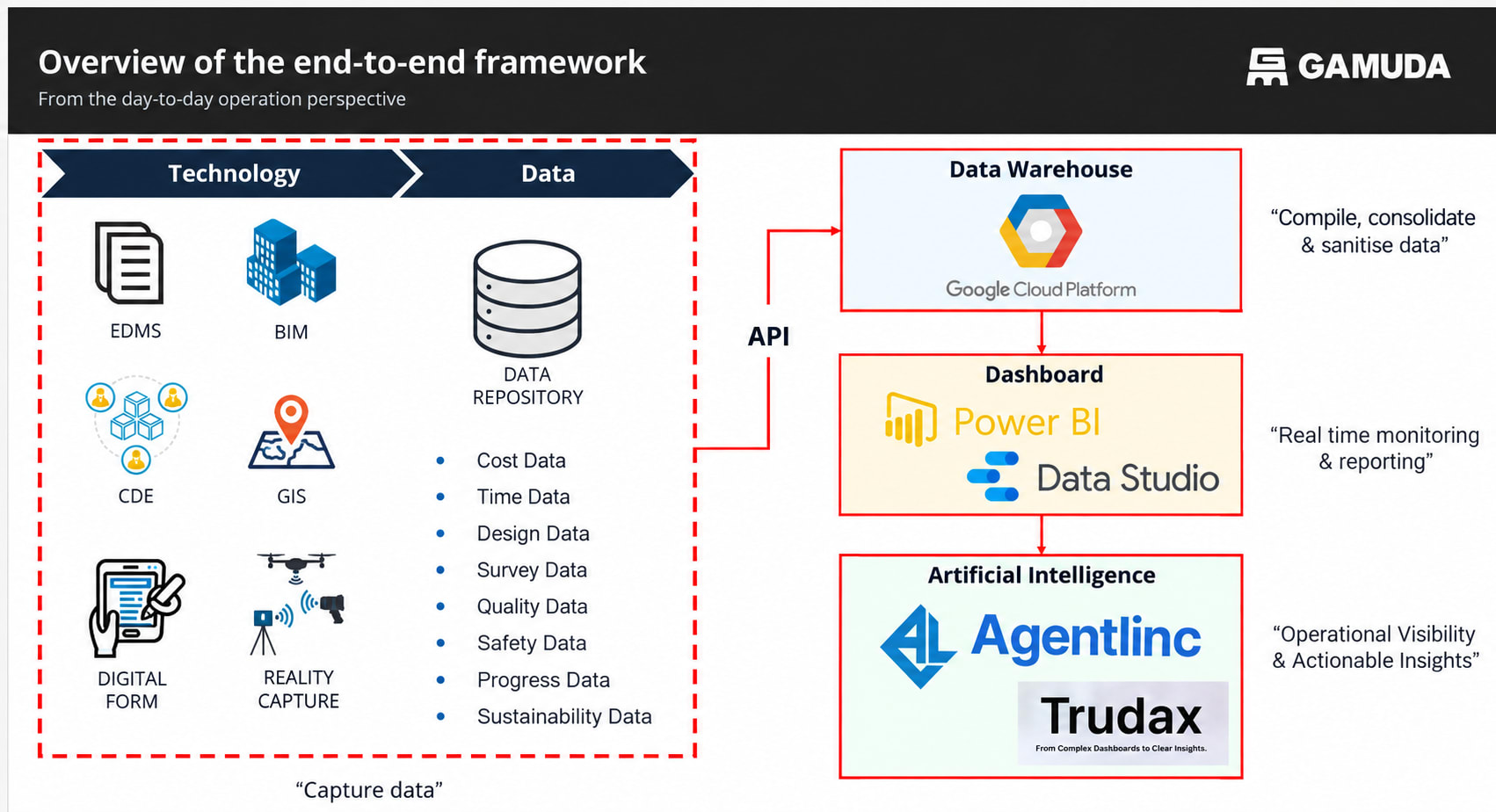
Gamuda’s data pipeline moves from operational capture to consolidation, reporting and AI-assisted analysis.
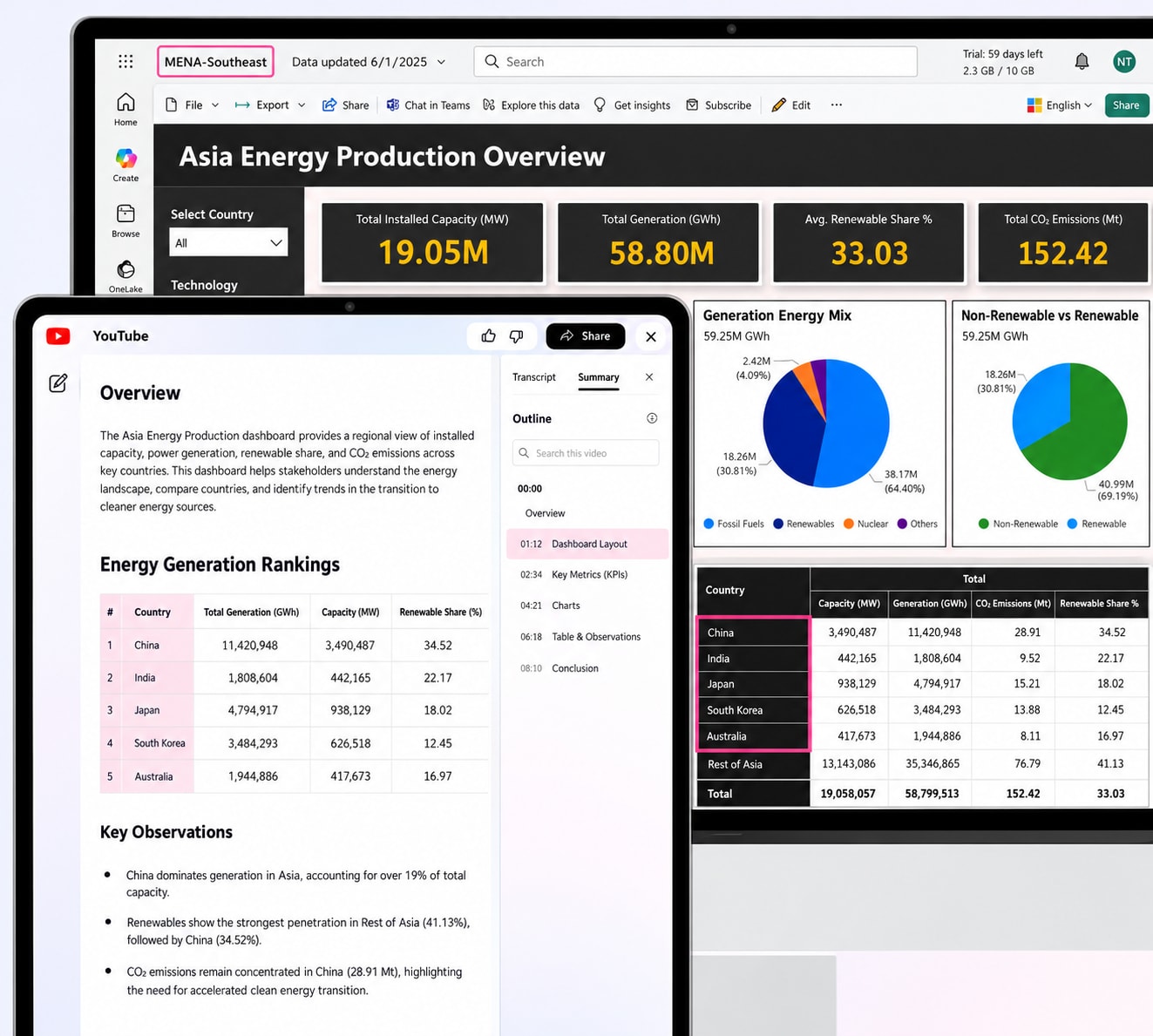
The progression does not stop at dashboards. Gamuda developed Trudax, an AI assistant connected to its Power BI dashboards, so users can interrogate trusted reporting through natural-language questions and receive answers linked back to the underlying dashboards. The significance is less the interface than the sequence: capture first, standardize and consolidate second, then apply analytics and AI to data that teams already use and trust.
|
CONNECT |
AI is downstream of operating discipline: Gamuda’s model treats insight and foresight as outcomes of reliable workflows and governed data, not as substitutes for them. |
EVIDENCE AT ENTERPRISE SCALE
|
Autodesk Forma facilitates Trudax upstream by helping Gamuda standardize and digitize project workflows - including common data, design coordination, field and cost-management activities - so project records are captured in a structured, reusable form. Through APIs and Gamuda's wider data architecture, that information can be consolidated in Google Cloud and surfaced in Power BI. Trudax then provides a natural-language layer over those trusted dashboards, routing questions to relevant sources and returning answers grounded in the data users are already authorized to see. The intended outcome is to shorten the path from project activity to decision. Instead of navigating multiple dashboards or waiting for manual extracts, users can ask a business question and receive a consolidated, traceable response linked back to the underlying dashboard. The advantages are faster access to critical information, less time spent compiling reports and cross-checking figures, and more time focused on interpreting trends, risks and actions - while preserving the governance and permissions already established in Power BI. |
Trudax provides a conversational layer over trusted Power BI reporting. |
Adoption is a leading indicator - operational evidence makes it meaningful
Autodesk Forma usage grew from 2,642 monthly active users in March 2024 to 8,561 in July 2026, a 224% increase. Gamuda interprets that adoption as evidence that more project processes are being digitized and more structured data is being generated. Usage alone is not the business outcome, but sustained use is a prerequisite for every downstream benefit the operating model is designed to create.
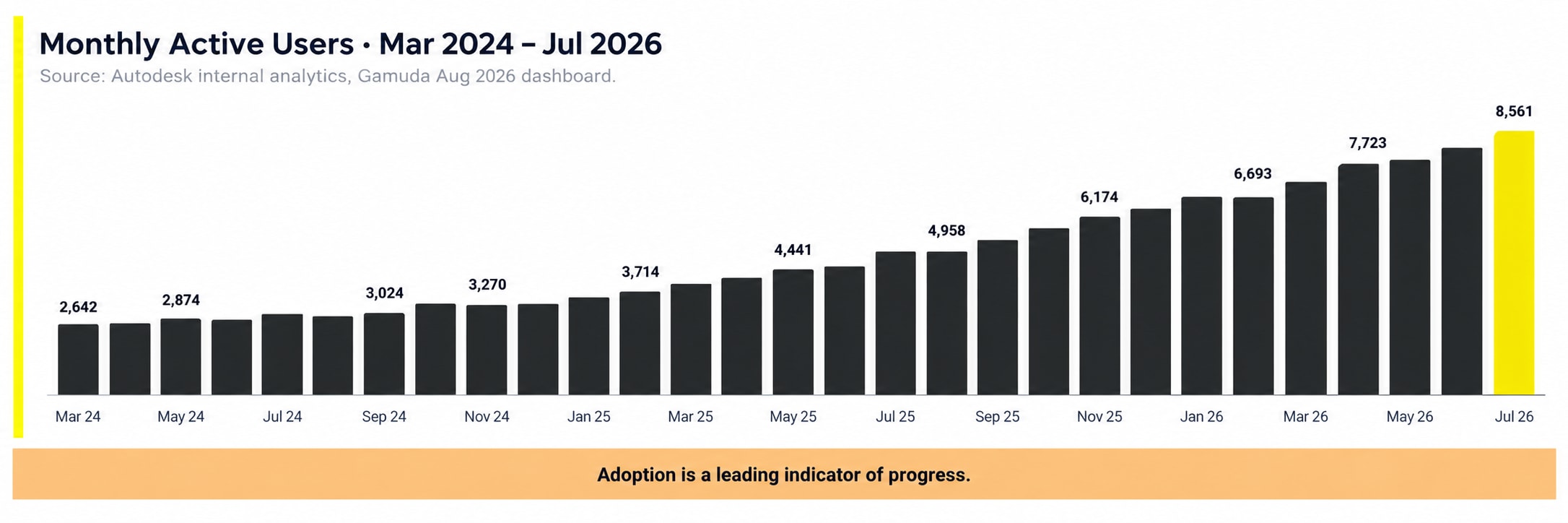
Monthly active users, March 2024 to July 2026. Source: Autodesk internal analytics and Gamuda August 2026 dashboard.
|
900+ digital form templates supporting repeatable site processes |
8,000 field-management users across five countries |
40+ projects using digital cost-management workflows |
Across field management, Gamuda reports more than three million digital forms created since it began using digital forms on site, with more than 1,000 forms raised per project per month on average. Across cost-management workflows, more than 1,800 active users and more than 900 subcontractors have participated, with more than 8,000 payments certified, more than 2,000 variation orders processed and more than $2 billion in payments processed.
The scale matters because it changes the nature of the data. A handful of digitized projects can produce local visibility; a standardized operating model used across a portfolio can create comparable information and an enterprise view of performance.
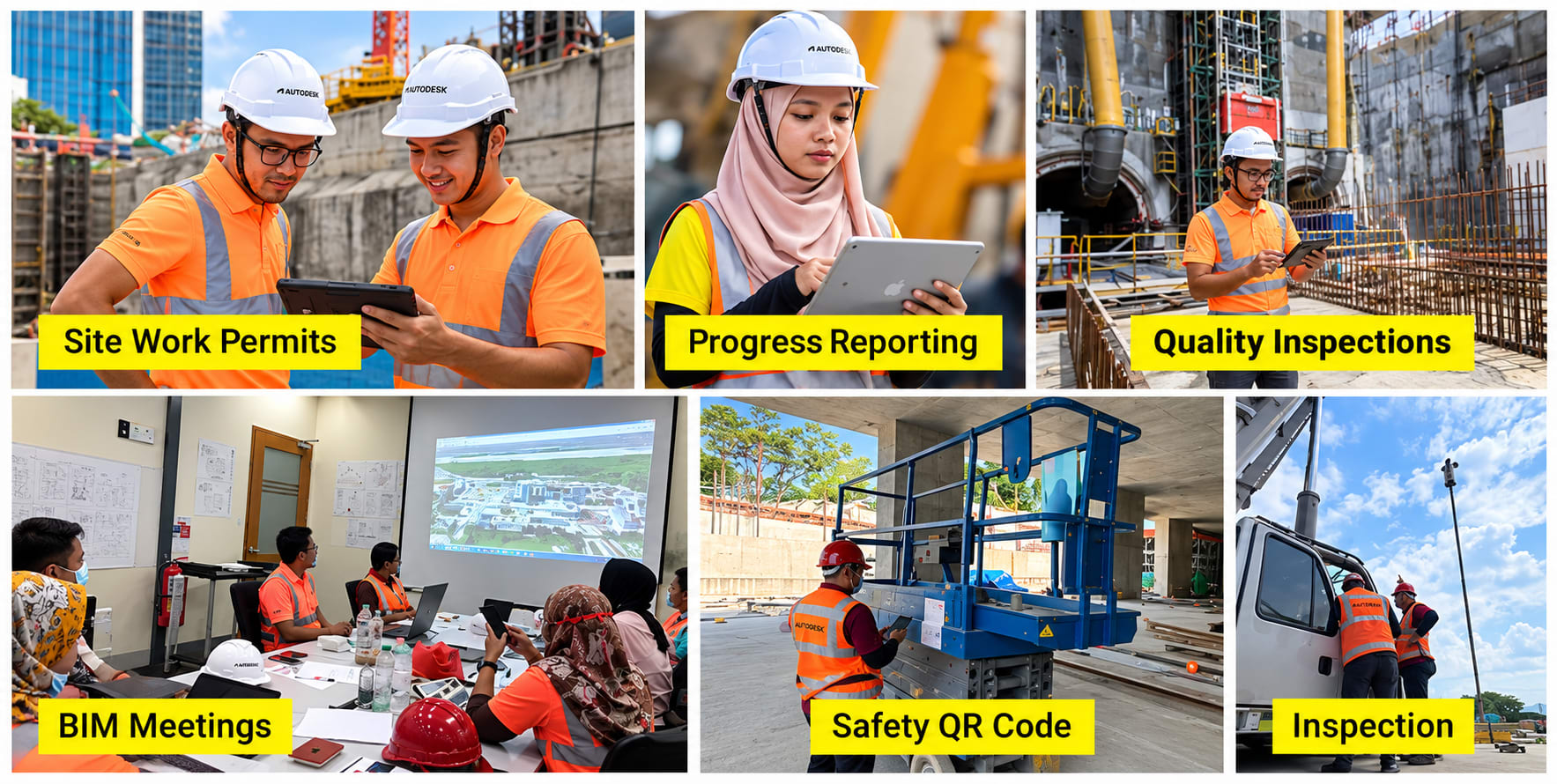
At site level, digital forms turn routine activities such as work permits, progress reporting and quality inspections into structured project records.
Three projects, one enterprise model
The strongest proof of Gamuda’s approach is not a single workflow. It is the way the same operating principles - common data, standardized processes, connected systems and structured capture - show up in different project contexts.
|
MALAYSIA | WATER TREATMENT Field workflows become operational data More than 730 project members use the digital environment. Since March 2023, the project has created more than 87,000 forms and identified more than 2,300 design and coordination issues. Automated routing for permits and other forms reduces manual approval chasing while creating structured records for near-real-time monitoring and simpler monthly reporting. |
|
|||||
|
AUSTRALIA | RAIL DEPOT Coordinate early, preserve continuity Multidisciplinary BIM models are federated in a common data environment so architecture, structural, MEP, rail and civil teams can coordinate issues in one place. The project has identified more than 500 design and coordination issues. Gamuda models an illustrative rework-avoidance scenario of AUD 2.5 million, assuming each of 500 issues would otherwise lead to AUD 5,000 of rework. It is a potential scenario, not a realized saving. |
|
|||||
|
SINGAPORE | RAIL PROJECT Connect model, progress and commercial process Gamuda connects BIM quantities and progress information with its cost-management workflow. Model elements are mapped through a common activity identifier so physical progress and commercial records can be traced through the process. The value is qualitative but material: fewer disconnected handoffs, clearer traceability, stronger visibility into progress-to-cost relationships, and a more continuous workflow for project and subcontractor teams.
Activity IDs connect model elements and workflow records, preserving traceability from physical progress to commercial process. |
|
PARTNERSHIP AND LESSONS
A partnership designed for continuous evolution
Gamuda owns its transformation model. Its Digital Operating Framework, convergence approach, standards, capability programs, BIM AR application, dashboards and Trudax reflect internal engineering and digital leadership. Autodesk’s role is different: to provide an evolving technology platform and a long-term partnership that supports connected workflows, interoperability, adoption and continuous improvement.
That distinction is important. Sustainable digitalization does not end when a platform is deployed. Project needs change, integrations mature, data volumes grow and new capabilities become possible. A continuing relationship gives Gamuda a way to align platform evolution with real delivery needs while retaining ownership of how its organization works.
What other organizations can learn from Gamuda
Start with business outcomes, not software. Gamuda frames digitalization around competitiveness, continuity, efficiency and faster, better-informed decisions.
Treat adoption as an operating capability. Executive sponsorship must meet working-level ownership, recurring training and trusted champions.
Standardize before scaling analytics. Comparable enterprise information depends on common workflows, templates and governance at the point where data is created.
Integrate the ecosystem. Use specialist systems for their strengths, then connect them so data and process can move across functional boundaries.
Turn operational work into structured data. Digital forms, BIM coordination, field records and commercial workflows become more valuable when their data can be consolidated and reused.
Govern the core, innovate at the edge. A stable enterprise foundation can coexist with internal innovation such as BIM AR and Trudax - and makes successful innovations easier to scale.
Earn AI readiness. Dashboards and AI become more credible when they sit on disciplined capture, data quality, consolidation and adoption.
Digital transformation that can endure
Gamuda’s experience shows why enterprise digitalization is best understood as an operating discipline. The technology matters, but its value depends on the system around it: leadership that sets direction, people who turn change into practice, standards that make work repeatable, integration that prevents new silos, governance that creates consistency, and data that can move from project record to enterprise insight.
When those elements reinforce one another, digital practices can survive project boundaries and leadership cycles. They become part of how the organization delivers work - and a platform for the next generation of analytics, automation and AI.
|
ADVANCE |
Explore Autodesk Forma for connected AECO workflows that help teams coordinate work, manage project information and build on trusted data across the project lifecycle. |
Presented at Autodesk University 2026
[Session: CS1724, "People Before Platforms: How Gamuda Made Change Stick with Autodesk Forma"]:
- Arthur Mun, Senior Manager, Digital Engineering, Gamuda
- Kelsey Stein, Senior Manager, Autodesk Consulting
Written by: Tushar Nath, Senior Customer Success Manager, Autodesk Inc.